
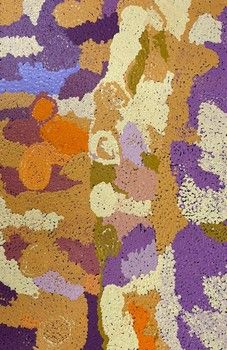
“Wantili (Warntili, Canning Stock Route Well 25) area, close to Parnngurr. My ngurra (home Country, camp), my jamu’s (grandfather’s) Country, my father's daddy, Jakayu [Biljabu’s] daddy and my daddy's Country. Jakayu been bury her father there. In pujiman (tradiƟonal, desert dwelling) days, my family and Jakayu's family been walking round there together. Big sandhills here. Sandhill, sandhill, sandhill everywhere. Claypan there, in the middle. Good place for swimming and drinking, for hunting little kangaroo. When no water [we would] go to [the adjacent Canning Stock Route] well. When there [was] rain we stay there at Wantili. Everywhere, we been walking everywhere. Near to Wantili, road [Canning Stock Route] going kayili (north). Long Ɵme [ago] only horses and cattle [travelled along that road], going Meekatharra and back in the cold Ɵme, gone right up to GJ (Georgia) Bore. Half way, when he see water at Wantili, that mob would camp one night, bullock eating all the grass and men’s drinking water. One Martu been working with that mob, droving bullock. Every time he been give us meat, all the pujimanpa (desert dwellers).” - Ngamaru Bidu Wantili is a large round jurnu (soak) and linyji (claypan) near Well 25 on the Canning Stock Route. The Wantili region is dominated by claypans surrounded by tuwa (sandhills), and Nyilangkurr, a prominent yapu (hill) is located close to the eastern edge of the claypan. Following rain the typically dry claypans are filled with water, with the overflow from nearby waterholes flowing to Wantili. At that time, Wantili becomes an important place for obtaining fresh water for drinking and bathing. Wantili is significant for the fact that at this site Kartujarra, Manyjilyjarra, Putijarra and Warnman people would all come together for ceremonies during © Copyright for the artwork remains with the artist. Copyright for the text remains with Shire of East Pilbara (Martumili Artists) the pujiman era. Many jiwa (stones used by women for grinding seeds) from these times, including those used by Ngamaru's family, can still be found there today. Wantili lies within Ngamaru’s ngurra (home Country, camp) through her grandfather and father. As described in her account, Wantili was one of the sites Ngamaru knew inƟmately and travelled extensively with her family and other family groups, such as the Biljabu family. During the pujiman period Martu would traverse very large distances annually, moving seasonally from water source to water source, and hunƟng and gathering bush tucker as they went. Knowledge of water sources was critical for survival, and today Martu Country is sƟll defined in terms of the location and type of water. As Ngamaru recounts, Wantili also held significance for her as a site of contact between her family and kartiya (white people); drovers with their cattle travelling along the Canning Stock Route. The establishment of the route by Alfred Canning and his team in 1910 resulted in first contact with Europeans for many Martu, including Ngamaru and her family. Increasingly, Martu followed the route to newly established raƟon depots, mission and pastoral stations. They were drawn to the route in search of food, by a sense of curiosity, or by loneliness. By the late 1950s and early 1960s, most of the desert family groups had left the desert. Eventually, these factors combined with an extreme and prolonged drought in the 1960s to prompt the few remaining pujimanpa to move in from the desert. Culturally, Wantili is an incredibly important site in two central Jukurrpa (Dreaming) stories. The first relates to the world’s creation. In this narrative, the world was initially dark, and people were like rocks, with no arms or legs. Following the sun’s first rising, lifeforms become increasingly complex while particular features in the land are created. Beyond these details much of the narraƟve is ngurlu (sacred, taboo), and only for Martu, but the site is open, and anyone can go there. WanƟli is also one of the many sites featured in the epic Minyipuru (Jakulyukulyu, Seven Sisters) Jukurrpa story. Minyipuru is a central Jukurrpa narrative for Martu, Ngaanyatjarra, Pitjantjatjara and Yankunytjatjara people that is associated with the seasonal Pleiades star constellation. Relayed in song, dance, stories and paintings, Minyipuru serves as a creation narrative, a source of information relating to the physical properties of the land, and an embodiment of Aboriginal cultural laws. The story follows the movement of a group of women travelling all the way across the desert, beginning at Roebourne on the coast of Western Australia, as they are pursued by Yurla, a lusƞul old man. As the women travelled, they stopped to rest at many sites to eat, dance, rest and sing, on the way leaving behind an assortment of articles that became formations in the land, such as groupings of rocks and trees, grinding stones and seeds. The sisters rested at WanƟli before throwing seeds, then continued their journey far to the east and beyond Martu Country, stopping at various sites through central and South Australia. Martumili Artists was established in late 2006 and supports Martu artists in Kunawarritji, Punmu, Parnngurr, Jigalong, Warralong,Irrungadji (Nullagine) and Parnpajinya (Newman). Many Martu artists have close relaƟonships with established artists amongst Yulparija, Kukatja and other Western Desert peoples and are now gaining recognition in their own right for their diverse, energetic and unmediated painting styles. Their works reflect the dramatic geography and scale of their homelands in the Great Sandy Desert and Rudall River regions of Western Australia. Martumili Artists represents speakers of Manyjilyjarra, Warnman, Kartujarra, Putijarra and Martu Wangka languages, many of whom experienced first contact with Europeans in the 1960s. The artists include painters, working in acrylics and oils, as well as weavers coiling baskets and sculptors working in wood, grass and wool. Martu artists proudly maintain their creative practices whilst pursuing social and cultural obligations across the Martu homelands.

